
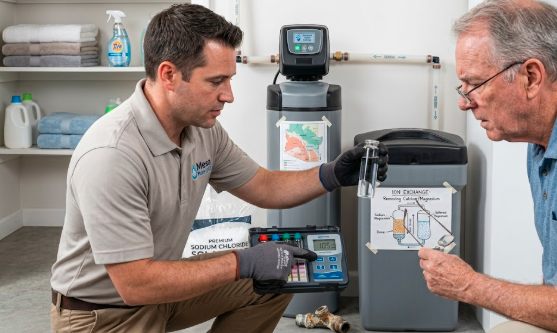
Your showerhead did not fail because of a bad batch or a manufacturing defect. The water flowing through every tap in this city carries a mineral load aggressive enough to clog, corrode and kill fixtures in under a year, and if you live in Mesa, Gilbert, Chandler or anywhere along the Salt River Valley, you have already seen the proof in your own bathroom. We install and service whole home softening systems right here in Mesa, and this page explains exactly why your showerhead lost the fight so quickly, plus what actually fixes it for good.
Why City Water Destroyed Your Showerhead So Fast
Mesa’s municipal supply carries an extremely high mineral load. The city draws primarily from the Salt River Project and from the Colorado River through the Central Arizona Project canal system. Along the way that water travels through limestone formations and gypsum deposits, picking up dissolved calcium carbonate and magnesium along with calcium sulfate. By the time it reaches your home, Mesa hard water measures in the range of 12 to 13 grains per gallon; a level the US Geological Survey classifies as very hard.
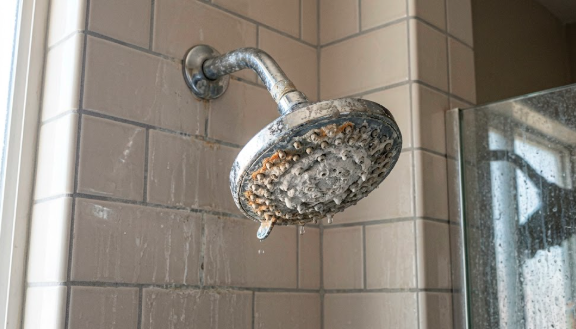
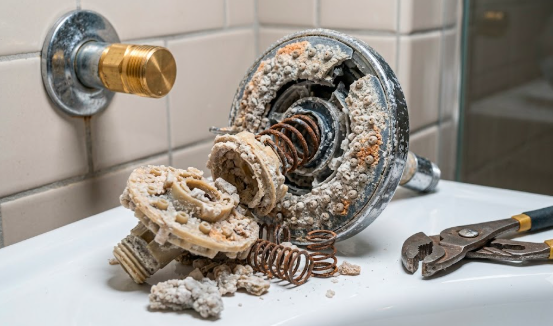
Every gallon that passes through your shower fixture carries dissolved rock. When hot water exits a nozzle, some of it evaporates instantly and the calcium and magnesium it was carrying stay behind as solid deposits. Those deposits accumulate inside the tiny nozzle holes layer after layer, week after week. Within months the holes narrow, pressure drops, spray patterns turn uneven, and the internal components corrode from constant mineral contact. This is what plumbers across the valley see on service calls almost daily.
The Warning Signs Homeowners Usually Miss
Most Mesa homeowners notice small changes long before a showerhead fully fails:
- Reduced water pressure that worsens gradually rather than all at once.
- Uneven spray patterns, with some nozzles shooting sideways while others barely trickle.
- White, chalky crust forming around the showerhead face and threading.
- Soap that will not lather properly, requiring more shampoo and body wash than usual.
- Spotted, cloudy glass on shower doors that reappears within days of cleaning.
These are not isolated cosmetic issues. They are symptoms of one underlying cause, and they tend to show up across your entire plumbing system at the same time, including faucets, water heaters and appliances.
It Is Not Just Your Showerhead
The same scale that clogs a showerhead also builds inside water heater tanks, reducing efficiency and shortening the appliance’s working life. We cover that in detail in “Why Mesa’s hard water is quietly killing your water heater.” Dishwasher spray arms clog. Washing machine valves scale over. Coffee makers and ice makers slow down and eventually stop working correctly. Copper fittings corrode faster under constant mineral exposure, and in older homes that sometimes leads to the pinhole leaks behind a pipe repair call. Mineral buildup in tank components is also a common reason a toilet will not stop running.
A showerhead is often simply the first fixture to show visible damage, because it processes so much hot water in a small, narrow space.
What Actually Solves This Problem
Replacing a showerhead treats the symptom, not the source. A new fixture in this water will scale over again within the same twelve-month window unless the water itself is treated before it ever reaches your pipes.
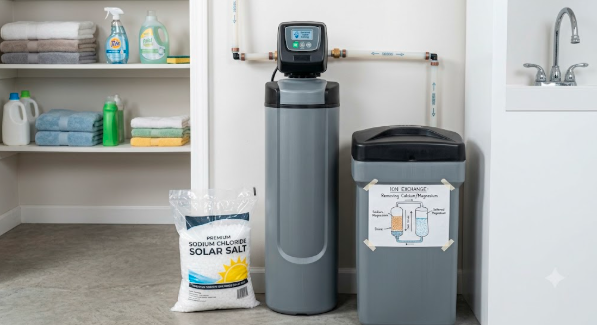
A properly sized whole home water softener addresses the problem at its source. These systems use ion exchange to remove calcium and magnesium from your supply before it circulates through the house, replacing hard minerals with sodium or potassium ions. The result is water that no longer leaves deposits behind, which protects showerheads, faucets, water heaters and every water-using appliance at the same time.
Homeowners who install a softener typically notice several changes within the first few weeks:
- Showerheads stay clear and hold consistent pressure for years instead of months.
- Soap and shampoo lather more easily, and skin and hair often feel noticeably softer.
- Glass shower doors stay clearer with far less scrubbing.
- Water heaters run more efficiently, since scale no longer insulates the heating element.
- Appliances last longer, from dishwashers to washing machines to ice makers.
If a fixture is already too far gone, faucet and fixture repair can be handled at the same visit as the softener install.
Why This Matters More In Mesa Than Almost Anywhere Else
Mesa sits in one of the hardest water regions in Arizona. Combine that with summer heat that pushes water heaters and appliances to work harder for longer stretches of the year, and the mineral load creates faster wear than most homeowners expect. Cities relying on softer surface water rarely see fixture damage on this timeline. Here, untreated fixtures are almost guaranteed to show visible mineral damage well before their expected lifespan runs out. Seasonal ground movement adds its own problems too, which is why our monsoon season plumbing checklist is worth a read before the storms arrive.
Local, Licensed Water Treatment for Mesa Homes
We specialise in diagnosing hard water damage and installing whole home softening systems sized correctly for Mesa households. Our technicians test your actual hardness on site, walk you through the right system for your home size and usage, and handle installation from start to finish. You can verify any contractor’s licence with the Arizona Registrar of Contractors before booking, and we would rather you did. If your showerhead, water heater or appliances already show mineral buildup, we can advise on descaling, repair or replacement alongside the softener so the whole system is protected going forward.
Frequently Asked Questions
Why does my showerhead in Mesa clog so quickly compared to other places I have lived?
Mesa hard water typically falls between 12 and 13 grains per gallon, driven by mineral rich sources like the Salt River Project and the Colorado River. That is significantly above the national average, which is why fixtures here scale over faster than in cities with softer water.
Will a new showerhead fix the problem permanently?
No. A replacement fixture will scale over within roughly the same timeframe unless the supply itself is softened before it reaches the fixture.
How often should I clean my showerhead if I do not have a softener yet?
Soaking it in a vinegar solution every four to six weeks slows the buildup, though it will not stop it entirely at this hardness level.
Does a water softener really protect my water heater too?
Yes. Softened water prevents scale forming inside the tank, which helps the unit run efficiently and typically extends its working life considerably.
How long does a whole home softener installation take?
Most residential installations in Mesa are completed within a single day, and technicians normally test your hardness on the same visit.
If your showerhead, faucets or appliances already show the early signs above, get in touch and we will assess your home’s specific hardness and recommend the right long term fix.